Saturday, April 4, 2009

The Return of the Crunchy-Granola-Dirty-Hippie

At home, I knew it was Saturday when I heard my father collecting the house’s trash bags to take to the dump. In Providence, the sound of the garbage truck woke me early each Tuesday morning. In Pittsburgh, when I found myself vaulting over trash bags on my morning run, I knew it must be Thursday—South Side’s garbage day.

In Jamaica, there are no such cues. Rather, the smell of burning trash and the sight of gray smoke spirals is a perpetual occurrence. These trash fires, seen in developing countries over the world, are a symbol of systemic poverty. There is no sanitation in Mount Friendship—or Devon Pen—or King Weston—or Tom’s River. The poor dump their rubbish into a gully and then set fire to it. The smells are terrible, the charred remnants are ugly, and the released fumes are toxic. But for the forgotten people in the hills, there is no alternative.

I was all about the Earth in college. Friends dubbed me the "crunchy-granola-dirty-hippie." I separated cans and bottles and ranted about going green. I ate organic and had a brief stint at an organic co-operative farm. I even wore a grubby “reduce, reuse, recycle” t-shirt that made my roommates Mandee, Nicole, and Sarah plot my death.

I quickly realized, however, that Jamaica is not particularly “eco-friendly.” (Much to the dismay of my crunchy-granola side.) It was not until we stumbled upon some Peace Corps Sanitation Volunteers that we realized we had options.

Bill and Gail, our newest set of Peace Corps friends, told us about a partnership they had developed with local government officials—if they could get the people in the poor mountain areas to recycle, a company would come collect these recycled materials. They invited us to join them, provided us with the recycling canisters and the rules, and told us to give it a try.

We, the Passionist Volunteers, decided to start small—we planned to start in each of our schools. As with any service or justice initiative, one must begin with education. The four of us designed a curriculum based on children’s books about pollution and on protecting the Earth. I, naturally, turned to the Doctor.

The Lorax is a Dr. Seuss classic that features a forest of Truffala Trees and an evil gremlin named the Once-Ler who chops them all down and pollutes a fragile ecosystem. The character of the Lorax speaks for the trees and urges the greedy Once-Ler not to pollute. I decided that the short, mustached and adorable (and so very eco-conscious) Lorax would be the perfect person to remind children to protect their world.

I presented my curriculum to the staff of Mount Friendship’s school and it was surprisingly met with enthusiasm. We planned to start by recycling plastic: plastic bags, bottles, bottle caps—everything plastic. The staff gave me their full support and encouragement and agreed to help me with the project.

We kicked off the initiative on April 1st and my dirty-hippie side, a side that had lain dormant for months, was unleashed. I brought up the barrel, posters explaining recycling, a hand-painted sign where the Lorax reminds us to recycle, and a handful of worksheets. I read each grade the story of the Lorax, gave them their own Loraxes to color, and talked about what their job will be over the course of the next month. They are to put any plastics they see into the bin and the best recyclers will get prizes each week.
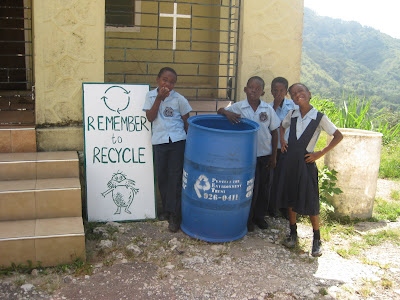
This is an experiment. As volunteers, our hopes are modest: we know we work in areas that are destitute. The people with whom we work are not particularly concerned about saving the Earth—their worries focus on feeding their children and keeping a roof over their heads. But we hope that this project will give them dignity—a chance to escape the toxins of the plastics and a place to put their garbage. Volunteer work is all about sustainability: Can your project survive? How will it last if you abandon it? We are not yet sure that this project is sustainable. We are giving it until Earth Day: April 22. It is then that the schools will tell us if this is something they want to continue on their own terms.

I can’t give Mount Friendship a garbage collection day. I can’t even give them my recycling t-shirt (sorry, girls). All I can offer them is an alternative to their current method. Will it work? I don’t know—but I’ll keep you posted.

Sunday, March 29, 2009

Lots of Good Fun

I like structure and order. A lot. I like schedules, lists, and consistency. I have always known this about myself, and so living in a developing country tends to throw me for a loop now and again.

Due to this desire for stability, I thought it would be a good idea to run a camp for the children of Mount Friendship when the school closed down for the island-wide Grade Six Achievement Test last week. I wanted to give the kids a healthy and structured play day, get them off the streets, and get something into their empty stomachs.

I fancied myself as modern day Cat in the Hat—bringing “lots of good fun that is funny" and so I started to plan.

The preparations were very orderly: I asked for advice from teachers and church members, I made advertisement fliers, and I spoke in each of the classrooms to invite the children. I organized donations of cookies and crackers to feed the kids, I sorted out sports equipment, learning games, and arts-and-crafts supplies. I appointed a few student leaders to act as counselors. I struck a deal with my favorite taxi driver and arranged transportation for myself and all of the materials. I expected a turnout of maybe 15 or 20 children. I was set. Or so I thought.

The camps, or “Fun Days” as I called them, were held in two separate locations. Thursday’s was held at Iron River Ball Field and Friday’s took place at the Mount James Ball Field. Iron River and Mount James are two communities that feed into Mount Friendship’s All-Age School, and conveniently, have large dirt pits that serve as soccer fields. The five student leaders I had appointed met me at the ball field the first morning with shining, scrubbed faces and helped me carry the water and juice, a box of toys, and a bag of sporting equipment into an abandoned building. They had swept it out and picked up the trash on the ball field. I was delighted. But the starting time came and went and no one was there. I hadn’t planned on that.

And then, over the crest of the hills, they came! The children came in droves—with friends from other schools, with their brothers and sisters, with their mothers. My nametags quickly ran out, the learning stations I had carefully created were demolished, and it became evident that the juice I had brought simply was not going to be sufficient. I hadn’t planned on that, either.

But I also hadn’t planned on the concept of “no problem, mon.” Jamaicans don’t sweat the small stuff; why should I?
The children played freely with the supplies. An intense soccer match soon developed. Little girls took the buckets I had brought and went fishing in the river. One of the mothers appeared with sugar and more water and managed to stretch the juice for everyone. Another mother organized an efficient line at snack time and handed out the biscuits before I knew what was happening. The teenagers who had appeared created a schedule of races and jumping rope contests.

The second day had a few more hiccups, including a lost soccer ball, a broken Frisbee, and a fistfight between two 7-year-olds. But when I told them I needed their help, my student leaders stepped up their game; organizing the little ones, redirecting whining children, passing out the snack, and organizing a cricket game, complete with twig wickets. I plan. It’s what I do. I am learning, however, that even the most meticulous of plans do not always work in the wild bush of Jamaica. Children can be rough and supplies can run out. A small, one-day camp for children turns into a community event—but that is okay—it is wonderful. At times, the event was chaotic, but it was beautiful chaos. Here, it truly does take a village to raise a child—and a volunteer.

I owe the success of the Fun Days to my teen leaders and the mothers in the communities—my fun days were fun thanks only to their involvement. My plans were necessary--they were crucial to laying the foundation. However, the villages of Mount Friendship, Iron River, and Mount James taught me that planning can take you only so far.

Dr. Seuss tells us: “It is good to have fun, but you have to know how.” Even the Cat in the Hat falls when he tries to hold up two books, the fish, a little toy ship and some milk on a dish. I would have fallen too, if not for the community’s support. If I wish to accompany these communities as they grow and develop, I must rely on their wisdom, spontaneity, and enthusiasm. Last week, I brought the books, the games, and some milk on a dish. Mount Friendship, Iron River, and Mount James knew how to bring the good fun that was funny.

Sunday, March 15, 2009

Stepping Aside


The job of a Passionist Volunteer is varied and wide-ranging. We are expected to visit the elderly, help the teachers, feed the poor, and be an advocate for the sick. But we are also asked, for one week during our year, to minister to a group of students from the Elms College in Chicopee, Massachusetts.

Alternative spring breaks are all the rage in the United States: college students step away from their lives of comfort to spend a week in a poor area as a volunteer. I myself gave a couple of weeks throughout college—to a reservation in Arizona and an orphanage in the Dominican Republic. Those trips are the very reason that I live in Jamaica today. Those brief immersions into the lives of the indigent poor opened my eyes, inspired me, and drove me to work for justice.

To be given the opportunity to step to the other side was quite an experience. It was unnerving to be purchasing the food, deciding on the projects, and leading the reflections. We were warned that it might be difficult to see others do the work we have been doing for months and to bond with people we consider our friends and family.

The Elms students experienced some bumps along the way—injuries and stomach issues being the top offenders—but we did watch them step, if only briefly, into our roles. We, as the PVI’s, gave the tours of the missions and made the introductions, and then put the students to work. They did everything from shadowing teachers in the classrooms to corralling goats in the evenings to painting the church in Devon Pen.

We PVI’s led small prayer and reflection services in the evenings to help the students process their experience. We asked them, over the course of the week, their motivation for coming, what they were learning and feeling, and how they felt that the experience changed them. These students came to Jamaica for many of the same reasons that we, as long-term volunteers, came to this island. They wanted to experience a new culture; they wanted to step out of their comfort zones; they wanted to make a difference.

Pope John Paul II, in his poem Shores of Silence, tells us “you must always step aside for someone from beyond.” Stepping aside during this past week allowed me a chance to see the beauty of Jamaica and its people once more. Seeing my work—my whole life, essentially—through greener and more innocent eyes was refreshing. Rather than grow possessive of our work here, stepping aside made us realize how poignant our everyday experiences are. The college students’ awe at the mountains made me appreciate the majesty of the misty peaks all over again. Their squeals during our rides into the hills made me remember my own initial trepidation at the winding roads. Their love for the people made me hug my children tighter and love my elderly friends more dearly.

The students with whom we worked are beautiful young women; they are bright, courageous, and eager to serve. It was a privilege to work with them over the course of the week and it was an honor to step aside for them. I tried to convey one final thought to them as they returned home; that this experience will change them forever. Once one has walked with the poor in this way, there is no return to the life you once led. And as JP 2 advised me to step aside, I want to pass on some more of his wisdom to these short-term volunteers:


You must know—there is no return
From this flow, this embrace within the mysterious beauty of Eternity.

Saturday, February 14, 2009

Love Story

The longer I am in Jamaica, my harder my blog entries have become to compose. The people about whom I write are no longer characters in the book of my service year in Jamaica; they have become my friends, my family, and my home. I struggle to write this very entry because the people whose story I am about to tell are very dear to me. But I think that this is a story that needs to be told.

When I started this entry, I wanted to tie it in with Valentine’s Day. But then I realized that the story I want to tell is not about romance and flowers and heart-shaped boxes of candy. It is a love story, but it is an uncommon love story.

Mr. Osbourne Brooks and Mrs. Edith Brooks have been part of the PVI experience for all volunteers working in Mount Friendship. “Aunt Edith” was a faithful member of Mount Friendship’s Catholic community until she fell ill several years ago. Since then, volunteers have visited her, prayed with her, registered her for the National Health Fund, and enjoyed the presence of her peaceful nature.

However, to visit Aunt Edith meant that the volunteer would also come to know the gruff Mr. Brooks, for Mr. Brooks was utterly devoted to Edith and rarely left her side. He cooked for her on his coal-and-zinc stove, he fed her, and he bathed and dressed her. On good days, Mr. Brooks would help Aunt Edith outside to sit and enjoy the sunlight while he would do small repairs or sort out the food he grew on his bush farm. They would speak quietly to each other, often saying a great deal without exchanging many words. The couple had known each other for years, but did not marry until late in life. And although they did not have any biological children, the two “grew a ‘ole ‘eap a pickney” over the course of their marriage—they took in dozens of children and raised them as their own.

I loved to visit with them and to watch the adoring looks that they traded and the gentleness with which Mr. Brooks handled Edith. Mr. Brooks would give me callaloo spinach to shred while he teased me about my nonexistent love life or he would let me give Aunt Edith her afternoon cup of tea.

Sadly, Aunt Edith’s condition worsened and she passed away in early January. One of her adopted children asked me to come to the house the following morning to sit with Mr. Brooks. However, when I arrived, Brooks was nowhere to be found, and no one knew where to find him. I drove the winding roads, stopping everyone I saw to ask if they had seen Brooks. The responses followed the same pattern—he had been crying, and he had gone into the bush. He clearly wanted to be alone, and I reluctantly gave up my search.


At Aunt Edith’s funeral, Mr. Brooks sat silently in the first row and wept silently throughout the mass. Jamaican funerals tend to be dramatic affairs, but I could not pay attention to the proceedings—all I could see was a man grieving the loss of the love of his life.

It seemed as if Aunt Edith’s death was a blow from which Mr. Brooks could never recover. During the days following her death, he wandered the roads for hours, for there was longer a reason for him to stay at home. He went to every service that every church in the area offered and he seemed to be searching desperately for solace.

But then, I began to see glimmers of the old Mr. Brooks. I came across a photograph of Miss Edith and brought it into church one Sunday. He gazed at the image and mopped at his eyes with a handkerchief, but he was smiling at her image through the tears.

Recently, I found more evidence that Mr. Brooks was starting to feel like himself again. I stopped by his home one morning on my way to the school, and when my cell phone rang, he seized the opportunity to fall back on his old joke: “De boyfriend call fi you?” He asked. I assured him that he is the only man in my life, and he grinned widely at me before turning back to a chair he was fixing. After a few moments of silence, he spoke again.

“My girlfriend, my wife, she was my honeycomb,” Mr. Brooks murmured.
“Why is she a honeycomb, Mr. Brooks?” I asked.
“Because nuttin nah sweeter den honeycomb,” he answered.

For Mr. Brooks, nothing in this world will ever be sweeter than Edith.

The people with whom I spend my time are not characters in a story—they are people with their own flaws, virtues, and quirks, and they are more real to me than anything else I have ever encountered. But the lives they lead and the dignity with which they handle their challenges provides a story that I feel compelled to impart to others.

The story of Mr. Brooks and Aunt Edith is one that I think needs to be shared; it is not only a love story, it is a story of devotion, dedication, and, when it comes right down to it, it is a story that has the sweetness of honeycomb. I wish you all the happiest of Valentine’s Days and I hope that you find ways to celebrate the uncommon love stories in your own lives.

Sunday, February 8, 2009

Happy Birthday, Mom!

I am posting this a few days early because we are leaving for a community retreat in Mandeville, but this Tuesday, February 10th, is my mother's birthday!

For those of you that don’t know Mary, she happens to be the most beautiful, sweet, intelligent and loving woman I have ever met. I am dedicating this entry to her, as without her love and support, I would not be able to do the work I do here in Jamaica.
It saddens me greatly that I am not home to help her celebrate this day. Please bear with me as this entry will probably be the cheesiest I ever write. If you do know Mary, make sure you wish her the happiest of birthdays.


2 Nalgene Bottles…$16.00 U.S.


1 Pair Hiking Sandals…$39.99 U.S.

3 Pounds Red Peas…$500.00 JA

1 Bag Jamaican Coffee…$203.00 JA

Having your daughter's students, the Mount Friendship church ladies, a dog named Stubby, and PVI 2008/2009 wish you a happy birthday...priceless.


I wish I could be home to celebrate, but know this: I love you, Mom.


Thursday, January 29, 2009

Child Labor


Archbishop Donald Reece, the Archbishop of Kingston, meets with every incoming group of Passionist Volunteers. He told our group, PVI 08-09, that we are to coach the youth as much as possible. We are to include them, teach them, and empower them. The communities need to belong to the youth.

My goal was to include them in the library project. Mount Friendship has never had a functioning library in its all-age school, and I’ve been trying desperately to change that. The books that my college friends sent renewed my energy for the project (Thanks again, guys) and I was ready to dive in headfirst with the help of the children. I expected them to be happy about the bags of books and willing to take on a role.

I didn’t think they’d take the project away from me.

The first Monday after the holidays, I drove the program’s white van up to Mount Friendship and asked a few boys to carry the book bags into the library classroom. Before I knew it, there were swarms of boys around the van, fighting for the privilege of carrying the sacks. The excitement was more than palpable. “Dem America books fi we, miss?” Yes, kids, those books are for you. The boys grabbed at the bags of books and ran into the library classroom with them.

I started sorting through the books during the day, and then invited the older children to help me. I gave a brief talk in a few classrooms about the help I needed, posted sign-up sheets on the side of the building, and promised to collect them at the end of the day. I shouldn’t have bothered. After the end-of-school prayer had been said, children were clamoring to get to the library. “Me, Miss!” they shouted as they jostled and elbowed their way into the tiny room, “Pick me!”

Surprised at the turnout, I directed them to the stations I had set up and we discussed the anatomy of a book. We talked about what a title means, what an author does, and who, exactly, an illustrator is. I pointed out the front cover, the back cover, the binding, and the spine. We talked about the right way to put books on a shelf (with the spine facing outward, to read the title) and talked about the concept of a library. Then they got down to business.

Mr. Bennett, the principal, Miss Forscythe, the grade 4 teacher, and I had devised a simple system to organize the books. We found envelopes that Jamaica’s humidity has sealed shut, and we cut them into triangles to be pasted into a book’s back cover. A card listing the title, author, the name of the person checking out the book, and the dates borrowed and returned goes into that triangle. We are keeping a handwritten list of all the books, a list that I enter into Excel on my laptop when I reach home in the evenings.

Within minutes, the room was a flurry of activity; students were pasting, taping, cutting, writing, shelving, and sneaking peeks into the colorful picture books at their fingertips. In shock, I stood awkwardly in the middle of the library. After so many months of struggling in the library as a solitary warrior, I suddenly found myself with nothing to do.

Thankfully, that changed quickly. “Miss!” “Miss!” Miss!” My name was being called from all over the room. I started circulating, answering questions and letting the kids know they were on the right track. Sometimes I had to point out the author’s name because it was hiding on the first page, not on the cover. Sometimes an envelope triangle was mistakenly pasted up-side down and had to be turned before the glue dried. As the afternoon wore on, there were fewer questions for me, but the energy level remained high.

The next afternoon was no less exuberant, nor was the following week, or the week after. I have sign-up sheets where children have committed to be a “paster,” a “writer,” a “counter,” or a “shelver” weeks into the future. The children have taught each other the jobs as well. Shamika was a paster last week. Although she is a shelver this week, she taught Jawayne the right way to glue the envelope to the back cover. Allier has trouble remembering who an author is, but Shandee is quick to remind him.

What is driving these children? What are they here for? Does the library give them camaraderie? Purpose? A chance to hold a colorful book? An identity? I don’t know the answers, but I love my willing laborers and I love that they have usurped my role. The library now belongs to them.

Wednesday, January 21, 2009

Welcome to the Peak


For my 22nd birthday, my roommates and I climbed Blue Mountain Peak. Standing tall at 2256 meters, it the highest point in Jamaica—I’ve got a thing for hiking and climbing, so this was a giant I had been eager to face. It was seven miles up, and upon reaching the summit, we found a sign that had been posted years before: “Welcome to the Peak!”

We had left in the early hours of the morning in hopes of catching the sunrise, but since our guide had not said a word from the moment we left the base camp, since it was pouring rain, since we had walked the majority of the way in darkness, and since our feet were covered in blisters, we turned around and headed back down the trail as quickly as possible.

I stand now at the peak. January 18th marks the six month anniversary of my time in Jamaica: I am halfway through, I have climbed the mountain. The next six months will be my journey back down the trail. The journey of the past months is not unlike my hike up the mountain, for my first steps were taken in darkness. I was blind to the culture, to the language, to the struggles of poverty, and to the everyday challenges of the developing world. But the activities of each day have enlightened and continue to enlighten me. Every person I meet, every experience I have opens my eyes a bit more. Every step I take in Jamaica is more sensitive, more aware, and more confident than the last.

I will always face rainy days, and the trail still gets rocky at times. But my guides in this journey are open and vocal and supportive: I have the teachers at Mount Friendship School. I have community pillars like Miss Doris and Mr. Brooks. I have my bosses, Father Lucian and Amy. I have the support of my community, Lauren, Michela, and Amber. I have family and friends that love me and the work I do here.

The darkness has lifted; I have gained a foothold on the trail of Jamaica. I have learned to stomp out roaches without screaming. I have learned how to cook ackee and saltfish. I have learned to effectively balance myself on busses careening around mountain roads. I have learned to navigate the Registrar General’s Department and the National Health Fund. I have learned to coach a child through Hop On Pop. I am learning to listen. I am learning to be easier on myself. I am learning to ask for help. I am learning to take it one day at a time and to cherish the small victories.

The day of the climb, we hurried back down the mountain, wishing for warmth, for dry clothes and for the pain in our feet to subside. The return journey was shorter—going downhill is always easier. But I have no intention of racing through the next six months. Everyone says that the second half of mission work tends to fly by, but I want to treasure each moment. I am growing closer to the adults and the children in Mount Friendship; I love them and I love the work that I have been granted the opportunity to do. Every day that slips past reminds me that my time here is limited, and that the laughs I share and the hugs I receive will come to an end all too soon.

As the morning of December 23rd wore on, the mists lifted, the sun came out, and our chilled skin warmed. We realized that our trek had not been in vain, for although we had left the peak, we were still able to enjoy the views of the Blue Mountains. I could look out over miles and miles of untouched and uninhabited mountains and hills. It was breathtakingly beautiful.
And from what I can see from where I stand right now, as Miss Betsy of Mount Friendship, the view is breathtaking.