Monday, April 20, 2009

Nyam wit yuh hand.


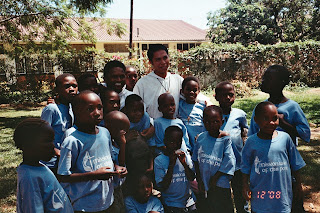
Lunchtime is chaotic in Mount Friendship’s all-age Catholic school. When the bell rings at noon, the children close their books, clasp their hands, and say a brief prayer in unison. Then, all hell breaks loose as they race across the dusty schoolyard to the window of a small outbuilding that serves as the canteen. They grab plates of white rice, stewed chicken, shredded cabbage, and a ladleful of juice. The meals are devoured back in the classrooms, and then the children dump their plates and utensils into a basin filled with water to soak. It is loud, it is messy, and it is overwhelming.

During my first few months at work in Mount Friendship, I stayed far away from the canteen, choosing instead to eat a peanut-butter and jelly sandwich on the church steps. I was intimidated by the bedlam, afraid of falling sick from the food, and I longed for the salads and spinach wraps of Raymond Cafeteria at Providence College.

However, as the days passed, I developed a friendship with the school’s cook and I learned Jamaica’s school lunch culture. Slowly, I found myself digging into the lunch routine and then, tentatively, into the lunch itself.

The lunch culture is complicated: if a child has seventy Jamaican dollars (a little less than one U.S. dollar), he gives it to the Grade 3 teacher, Miss Rufus, who then gives Marie, the school’s cook, a head count. There are some children who receive a free lunch through Jamaica’s PATH program: Program of Advancement Through Health. PATH came about through a partnership with the Inter-American Development Bank, and it has strict rules, one of them being that PATH students must attend school at least 85 percent of the month.

In Mount Friendship, however, the school lunch is a source of pride and shame. Often, children would rather skip school than admit that their families can’t afford their lunch that day—it is the main reason for the poor attendance rates at school. But thanks to Miss Rufus and Marie, the school is a place where children’s minds and bellies are filled. These women are fully aware of who hungers; it is Marie who slips the neediest children a plate of rice and it is Miss Rufus who utters the magic words: “Mek Marie give yuh a someting.”

For many children, school lunch is the only real meal they eat in a day—and, as I realized this fact, I began to understand the mad dash to the canteen.

As my confidence grew, I began excusing myself from whatever classroom I was in or leaving the library around 11:30 to help Marie organize the plates or mix the juice. She, like Aggie of the food bags, is strict about the portions (“Too much vegetable, too likkle rice!”) but she is patient with me. The canteen has a frenzied atmosphere when the children are getting their lunches, but handing out the meal and watching the children’s eyes light up does make for a truly pleasant experience.

Not too long ago, Marie and I were eating our own portions of rice and chicken after the children had been fed. “In Jamaica we have a saying,” she said, her eyes dancing, “put dung de fork an’ nyam wit yuh hand.” Eight months ago, the patois proverb would have been nothing more than gibberish, but on that day, her meaning was not lost on me: “Put down the fork and eat with your hand.”

Essentially, Marie’s words mean to roll up your sleeves and dig in. The distance I put between myself and the canteen in the beginning of the year is one I now regret, but it takes time to grow accustomed to another country and another culture. It wasn’t possible for me to “nyam wit mi hand” eight months ago, but it is now. I nyam it all now: the rice, the chicken, and the noontime feeding frenzy.
Saturday, April 11, 2009

Good Friday

Brevity reigns in the gospels when one examines Jesus’ walk to His death. His suffering--his falls, the assistance given to him by Simon--these details are given more clearly and passionately when Catholics throughout the world reflect upon that journey through the tradition of the Stations of the Cross.

My roommates and I were invited to join in this ritual in downtown Kingston with a Catholic order of brothers known as “Missionaries of the Poor.” As a third world order, the brothers are in Uganda, Haiti, India, and the Philippines—but their headquarters and their founder are in Jamaica. The MOPs have shelters throughout the Kingston area where they not only evangelize, but care for the destitute, the sick, and the physically and mentally handicapped. We have worked in these shelters before, but the Stations began at one we had not yet visited—Bethlehem House.

We arrived a few minutes early, and one of the brothers ushered us into the shelter for a brief tour, explaining that Bethlehem’s mission is to care for extremely handicapped children. During our past few months as volunteers, we have seen individuals with serious ailments, but the deformities I witnessed at Bethlehem surpassed all others. The sight of so many children with distorted and bowed bodies brought me to tears, and I barely had time to wipe them away before the service of the stations began.

The brothers that were to read the Stations of the Cross stood in the bed of a truck with microphones. Some brothers stood waiting to help the handicapped residents of the shelters to walk the stations, and still others stood waiting to take their turn to carry a wooden cross and wear a crown of thorns.

The first station was read, and we joined the procession of dozens of men, women, and children—either handicapped shelter residents or able-bodied community members—down the streets of Kingston.

My experience in Jamaica thus far has been in rural areas. Mount Friendship is a small village that is stunted by poverty, but its sorrows are tempered by cool mountain breezes and a natural tropical beauty. Downtown Kingston, however, looks as if it has been bombed, burned, and left to rot. It is stiflingly hot, dusty, and smelly. Shanties with zinc roofs are piled on top of each other, gang leaders known as “dons” mark their territories with violence and threats, and half-naked children scurry through the streets. There is no development and no industry on these mean streets, making Kingston the embodiment of third-world urban poverty.

And it was in this very setting that we began to walk. We sang simple hymns as we walked down unmarked streets lined with "tenement yards" and graffiti-filled zinc fences. And fourteen times, the brothers stopped, the crowd knelt, and the station was read. We went through the condemnation, the bearing of the cross, Jesus' three falls, the crucifixion...each station becoming more poignant with each step.

We walked these streets of the ghetto of one of the world’s poorest and most violent cities, in the noontime heat. We smelled the muck of the gutters, saw the grit of the streets cake onto our legs, and felt the sweat drip down our backs. Despite this, people were drawn to the procession. The sound of the hymns, the sight of the brothers dragging the cross, and the image of the faithful trudging through the ghetto made the procession swell from several dozen worshippers to almost two hundred.

Our walk was so very different from that one two thousand year ago, but like Christ’s, it was filled with suffering. The images of poverty: the zinc fences, the barbed wire, the filth, the crumbling buildings, and the haunted faces watching us reminded me that Jesus’ pain is always with us. I watched the brothers, Kingston’s poor, and the handicapped shelter residents sing of their love for Jesus and kneel on the blisteringly hot pavement. And, for the second time that day, I wept.

John, chapter 19 reads, "So they took Jesus, and carrying the cross himself, he went out to what is called the Place of the Skull, in Hebrew, Golgotha. There they crucified him." The Stations of the Cross give us a chance not only to recreate, but to relive Jesus’ suffering for ourselves. I was granted an unbelievable opportunity to walk the Stations with God’s people: the least of our brothers and sisters. I walked with the broken, the beaten, the sick, and the deformed. And their faith put mine to shame. Walking Jesus’ fourteen stops allows us to experience the range of human suffering, whether it be in the broken bodies in Bethlehem house, in the filth of a third-world city, or in our own hearts. Have a blessed and beautiful Easter.

Saturday, April 4, 2009

The Return of the Crunchy-Granola-Dirty-Hippie

At home, I knew it was Saturday when I heard my father collecting the house’s trash bags to take to the dump. In Providence, the sound of the garbage truck woke me early each Tuesday morning. In Pittsburgh, when I found myself vaulting over trash bags on my morning run, I knew it must be Thursday—South Side’s garbage day.

In Jamaica, there are no such cues. Rather, the smell of burning trash and the sight of gray smoke spirals is a perpetual occurrence. These trash fires, seen in developing countries over the world, are a symbol of systemic poverty. There is no sanitation in Mount Friendship—or Devon Pen—or King Weston—or Tom’s River. The poor dump their rubbish into a gully and then set fire to it. The smells are terrible, the charred remnants are ugly, and the released fumes are toxic. But for the forgotten people in the hills, there is no alternative.

I was all about the Earth in college. Friends dubbed me the "crunchy-granola-dirty-hippie." I separated cans and bottles and ranted about going green. I ate organic and had a brief stint at an organic co-operative farm. I even wore a grubby “reduce, reuse, recycle” t-shirt that made my roommates Mandee, Nicole, and Sarah plot my death.

I quickly realized, however, that Jamaica is not particularly “eco-friendly.” (Much to the dismay of my crunchy-granola side.) It was not until we stumbled upon some Peace Corps Sanitation Volunteers that we realized we had options.

Bill and Gail, our newest set of Peace Corps friends, told us about a partnership they had developed with local government officials—if they could get the people in the poor mountain areas to recycle, a company would come collect these recycled materials. They invited us to join them, provided us with the recycling canisters and the rules, and told us to give it a try.

We, the Passionist Volunteers, decided to start small—we planned to start in each of our schools. As with any service or justice initiative, one must begin with education. The four of us designed a curriculum based on children’s books about pollution and on protecting the Earth. I, naturally, turned to the Doctor.

The Lorax is a Dr. Seuss classic that features a forest of Truffala Trees and an evil gremlin named the Once-Ler who chops them all down and pollutes a fragile ecosystem. The character of the Lorax speaks for the trees and urges the greedy Once-Ler not to pollute. I decided that the short, mustached and adorable (and so very eco-conscious) Lorax would be the perfect person to remind children to protect their world.

I presented my curriculum to the staff of Mount Friendship’s school and it was surprisingly met with enthusiasm. We planned to start by recycling plastic: plastic bags, bottles, bottle caps—everything plastic. The staff gave me their full support and encouragement and agreed to help me with the project.

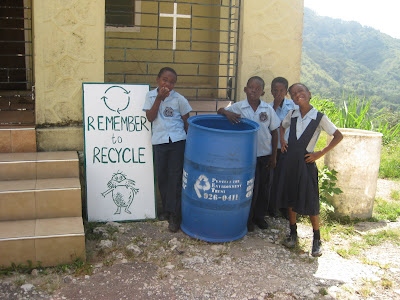
We kicked off the initiative on April 1st and my dirty-hippie side, a side that had lain dormant for months, was unleashed. I brought up the barrel, posters explaining recycling, a hand-painted sign where the Lorax reminds us to recycle, and a handful of worksheets. I read each grade the story of the Lorax, gave them their own Loraxes to color, and talked about what their job will be over the course of the next month. They are to put any plastics they see into the bin and the best recyclers will get prizes each week.
This is an experiment. As volunteers, our hopes are modest: we know we work in areas that are destitute. The people with whom we work are not particularly concerned about saving the Earth—their worries focus on feeding their children and keeping a roof over their heads. But we hope that this project will give them dignity—a chance to escape the toxins of the plastics and a place to put their garbage. Volunteer work is all about sustainability: Can your project survive? How will it last if you abandon it? We are not yet sure that this project is sustainable. We are giving it until Earth Day: April 22. It is then that the schools will tell us if this is something they want to continue on their own terms.

I can’t give Mount Friendship a garbage collection day. I can’t even give them my recycling t-shirt (sorry, girls). All I can offer them is an alternative to their current method. Will it work? I don’t know—but I’ll keep you posted.

Sunday, March 29, 2009

Lots of Good Fun

I like structure and order. A lot. I like schedules, lists, and consistency. I have always known this about myself, and so living in a developing country tends to throw me for a loop now and again.

Due to this desire for stability, I thought it would be a good idea to run a camp for the children of Mount Friendship when the school closed down for the island-wide Grade Six Achievement Test last week. I wanted to give the kids a healthy and structured play day, get them off the streets, and get something into their empty stomachs.

I fancied myself as modern day Cat in the Hat—bringing “lots of good fun that is funny" and so I started to plan.

The preparations were very orderly: I asked for advice from teachers and church members, I made advertisement fliers, and I spoke in each of the classrooms to invite the children. I organized donations of cookies and crackers to feed the kids, I sorted out sports equipment, learning games, and arts-and-crafts supplies. I appointed a few student leaders to act as counselors. I struck a deal with my favorite taxi driver and arranged transportation for myself and all of the materials. I expected a turnout of maybe 15 or 20 children. I was set. Or so I thought.

The camps, or “Fun Days” as I called them, were held in two separate locations. Thursday’s was held at Iron River Ball Field and Friday’s took place at the Mount James Ball Field. Iron River and Mount James are two communities that feed into Mount Friendship’s All-Age School, and conveniently, have large dirt pits that serve as soccer fields. The five student leaders I had appointed met me at the ball field the first morning with shining, scrubbed faces and helped me carry the water and juice, a box of toys, and a bag of sporting equipment into an abandoned building. They had swept it out and picked up the trash on the ball field. I was delighted. But the starting time came and went and no one was there. I hadn’t planned on that.

And then, over the crest of the hills, they came! The children came in droves—with friends from other schools, with their brothers and sisters, with their mothers. My nametags quickly ran out, the learning stations I had carefully created were demolished, and it became evident that the juice I had brought simply was not going to be sufficient. I hadn’t planned on that, either.

But I also hadn’t planned on the concept of “no problem, mon.” Jamaicans don’t sweat the small stuff; why should I?
The children played freely with the supplies. An intense soccer match soon developed. Little girls took the buckets I had brought and went fishing in the river. One of the mothers appeared with sugar and more water and managed to stretch the juice for everyone. Another mother organized an efficient line at snack time and handed out the biscuits before I knew what was happening. The teenagers who had appeared created a schedule of races and jumping rope contests.

The second day had a few more hiccups, including a lost soccer ball, a broken Frisbee, and a fistfight between two 7-year-olds. But when I told them I needed their help, my student leaders stepped up their game; organizing the little ones, redirecting whining children, passing out the snack, and organizing a cricket game, complete with twig wickets. I plan. It’s what I do. I am learning, however, that even the most meticulous of plans do not always work in the wild bush of Jamaica. Children can be rough and supplies can run out. A small, one-day camp for children turns into a community event—but that is okay—it is wonderful. At times, the event was chaotic, but it was beautiful chaos. Here, it truly does take a village to raise a child—and a volunteer.

I owe the success of the Fun Days to my teen leaders and the mothers in the communities—my fun days were fun thanks only to their involvement. My plans were necessary--they were crucial to laying the foundation. However, the villages of Mount Friendship, Iron River, and Mount James taught me that planning can take you only so far.

Dr. Seuss tells us: “It is good to have fun, but you have to know how.” Even the Cat in the Hat falls when he tries to hold up two books, the fish, a little toy ship and some milk on a dish. I would have fallen too, if not for the community’s support. If I wish to accompany these communities as they grow and develop, I must rely on their wisdom, spontaneity, and enthusiasm. Last week, I brought the books, the games, and some milk on a dish. Mount Friendship, Iron River, and Mount James knew how to bring the good fun that was funny.

Sunday, March 15, 2009

Stepping Aside


The job of a Passionist Volunteer is varied and wide-ranging. We are expected to visit the elderly, help the teachers, feed the poor, and be an advocate for the sick. But we are also asked, for one week during our year, to minister to a group of students from the Elms College in Chicopee, Massachusetts.

Alternative spring breaks are all the rage in the United States: college students step away from their lives of comfort to spend a week in a poor area as a volunteer. I myself gave a couple of weeks throughout college—to a reservation in Arizona and an orphanage in the Dominican Republic. Those trips are the very reason that I live in Jamaica today. Those brief immersions into the lives of the indigent poor opened my eyes, inspired me, and drove me to work for justice.

To be given the opportunity to step to the other side was quite an experience. It was unnerving to be purchasing the food, deciding on the projects, and leading the reflections. We were warned that it might be difficult to see others do the work we have been doing for months and to bond with people we consider our friends and family.

The Elms students experienced some bumps along the way—injuries and stomach issues being the top offenders—but we did watch them step, if only briefly, into our roles. We, as the PVI’s, gave the tours of the missions and made the introductions, and then put the students to work. They did everything from shadowing teachers in the classrooms to corralling goats in the evenings to painting the church in Devon Pen.

We PVI’s led small prayer and reflection services in the evenings to help the students process their experience. We asked them, over the course of the week, their motivation for coming, what they were learning and feeling, and how they felt that the experience changed them. These students came to Jamaica for many of the same reasons that we, as long-term volunteers, came to this island. They wanted to experience a new culture; they wanted to step out of their comfort zones; they wanted to make a difference.

Pope John Paul II, in his poem Shores of Silence, tells us “you must always step aside for someone from beyond.” Stepping aside during this past week allowed me a chance to see the beauty of Jamaica and its people once more. Seeing my work—my whole life, essentially—through greener and more innocent eyes was refreshing. Rather than grow possessive of our work here, stepping aside made us realize how poignant our everyday experiences are. The college students’ awe at the mountains made me appreciate the majesty of the misty peaks all over again. Their squeals during our rides into the hills made me remember my own initial trepidation at the winding roads. Their love for the people made me hug my children tighter and love my elderly friends more dearly.

The students with whom we worked are beautiful young women; they are bright, courageous, and eager to serve. It was a privilege to work with them over the course of the week and it was an honor to step aside for them. I tried to convey one final thought to them as they returned home; that this experience will change them forever. Once one has walked with the poor in this way, there is no return to the life you once led. And as JP 2 advised me to step aside, I want to pass on some more of his wisdom to these short-term volunteers:


You must know—there is no return
From this flow, this embrace within the mysterious beauty of Eternity.

Saturday, February 14, 2009

Love Story

The longer I am in Jamaica, my harder my blog entries have become to compose. The people about whom I write are no longer characters in the book of my service year in Jamaica; they have become my friends, my family, and my home. I struggle to write this very entry because the people whose story I am about to tell are very dear to me. But I think that this is a story that needs to be told.

When I started this entry, I wanted to tie it in with Valentine’s Day. But then I realized that the story I want to tell is not about romance and flowers and heart-shaped boxes of candy. It is a love story, but it is an uncommon love story.

Mr. Osbourne Brooks and Mrs. Edith Brooks have been part of the PVI experience for all volunteers working in Mount Friendship. “Aunt Edith” was a faithful member of Mount Friendship’s Catholic community until she fell ill several years ago. Since then, volunteers have visited her, prayed with her, registered her for the National Health Fund, and enjoyed the presence of her peaceful nature.

However, to visit Aunt Edith meant that the volunteer would also come to know the gruff Mr. Brooks, for Mr. Brooks was utterly devoted to Edith and rarely left her side. He cooked for her on his coal-and-zinc stove, he fed her, and he bathed and dressed her. On good days, Mr. Brooks would help Aunt Edith outside to sit and enjoy the sunlight while he would do small repairs or sort out the food he grew on his bush farm. They would speak quietly to each other, often saying a great deal without exchanging many words. The couple had known each other for years, but did not marry until late in life. And although they did not have any biological children, the two “grew a ‘ole ‘eap a pickney” over the course of their marriage—they took in dozens of children and raised them as their own.

I loved to visit with them and to watch the adoring looks that they traded and the gentleness with which Mr. Brooks handled Edith. Mr. Brooks would give me callaloo spinach to shred while he teased me about my nonexistent love life or he would let me give Aunt Edith her afternoon cup of tea.

Sadly, Aunt Edith’s condition worsened and she passed away in early January. One of her adopted children asked me to come to the house the following morning to sit with Mr. Brooks. However, when I arrived, Brooks was nowhere to be found, and no one knew where to find him. I drove the winding roads, stopping everyone I saw to ask if they had seen Brooks. The responses followed the same pattern—he had been crying, and he had gone into the bush. He clearly wanted to be alone, and I reluctantly gave up my search.


At Aunt Edith’s funeral, Mr. Brooks sat silently in the first row and wept silently throughout the mass. Jamaican funerals tend to be dramatic affairs, but I could not pay attention to the proceedings—all I could see was a man grieving the loss of the love of his life.

It seemed as if Aunt Edith’s death was a blow from which Mr. Brooks could never recover. During the days following her death, he wandered the roads for hours, for there was longer a reason for him to stay at home. He went to every service that every church in the area offered and he seemed to be searching desperately for solace.

But then, I began to see glimmers of the old Mr. Brooks. I came across a photograph of Miss Edith and brought it into church one Sunday. He gazed at the image and mopped at his eyes with a handkerchief, but he was smiling at her image through the tears.

Recently, I found more evidence that Mr. Brooks was starting to feel like himself again. I stopped by his home one morning on my way to the school, and when my cell phone rang, he seized the opportunity to fall back on his old joke: “De boyfriend call fi you?” He asked. I assured him that he is the only man in my life, and he grinned widely at me before turning back to a chair he was fixing. After a few moments of silence, he spoke again.

“My girlfriend, my wife, she was my honeycomb,” Mr. Brooks murmured.
“Why is she a honeycomb, Mr. Brooks?” I asked.
“Because nuttin nah sweeter den honeycomb,” he answered.

For Mr. Brooks, nothing in this world will ever be sweeter than Edith.

The people with whom I spend my time are not characters in a story—they are people with their own flaws, virtues, and quirks, and they are more real to me than anything else I have ever encountered. But the lives they lead and the dignity with which they handle their challenges provides a story that I feel compelled to impart to others.

The story of Mr. Brooks and Aunt Edith is one that I think needs to be shared; it is not only a love story, it is a story of devotion, dedication, and, when it comes right down to it, it is a story that has the sweetness of honeycomb. I wish you all the happiest of Valentine’s Days and I hope that you find ways to celebrate the uncommon love stories in your own lives.

Sunday, February 8, 2009

Happy Birthday, Mom!

I am posting this a few days early because we are leaving for a community retreat in Mandeville, but this Tuesday, February 10th, is my mother's birthday!

For those of you that don’t know Mary, she happens to be the most beautiful, sweet, intelligent and loving woman I have ever met. I am dedicating this entry to her, as without her love and support, I would not be able to do the work I do here in Jamaica.
It saddens me greatly that I am not home to help her celebrate this day. Please bear with me as this entry will probably be the cheesiest I ever write. If you do know Mary, make sure you wish her the happiest of birthdays.


2 Nalgene Bottles…$16.00 U.S.


1 Pair Hiking Sandals…$39.99 U.S.

3 Pounds Red Peas…$500.00 JA

1 Bag Jamaican Coffee…$203.00 JA

Having your daughter's students, the Mount Friendship church ladies, a dog named Stubby, and PVI 2008/2009 wish you a happy birthday...priceless.


I wish I could be home to celebrate, but know this: I love you, Mom.